
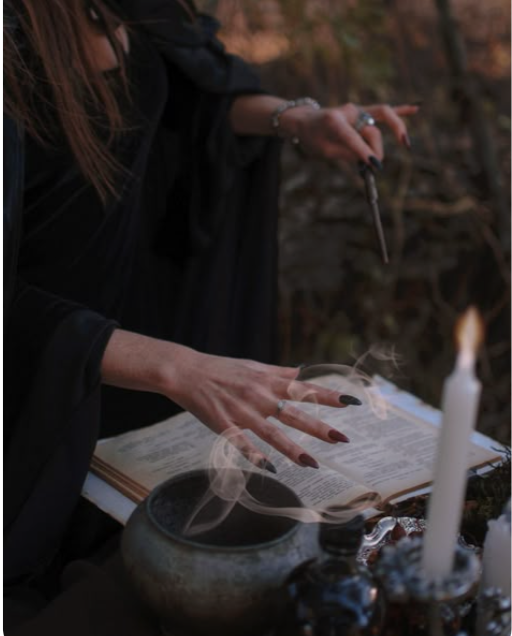
Chaos magick (often spelled “chaos magic”) is a modern, results-oriented approach to magick that treats belief like a tool.
Instead of committing to one tradition as “the truth,” chaos practitioners experiment: they adopt a belief system, symbol set, or ritual method long enough to create a change, then keep what works and drop what doesn’t.
The point isn’t to prove a cosmic doctrine.
The point is to produce real, measurable shifts in mind, behavior, perception, and life.
That mindset is exactly why chaos magick has a reputation for being both liberating and polarizing.
To some people it feels like the most honest form of magick: flexible, creative, pragmatic.
To others it can seem chaotic in the messy sense, like “anything goes.”
The reality is more nuanced: chaos magick is often highly disciplined, just disciplined around experimentation rather than tradition.
So what is a “chaos witch,” specifically?
“Chaos witch” isn’t a single official title with one rulebook. It’s more like a vibe and a method.
A chaos witch is usually someone who practices witchcraft (candles, herbs, moon work, spellcraft/ritual, divination, folk methods – whatever “witch” means to them) through the chaos magick lens: flexible belief, personal symbolism, testing, and constant iteration.
A chaos witch might do a candle ritual one week, sigil work the next, then borrow a visualization structure from a totally different system because their core commitment isn’t to one lineage.
Their core commitment is to what reliably creates change.
Core beliefs and views in chaos magick
The cornerstone idea you’ll hear again and again is: belief is a tool. If reality is filtered through perception, and perception is shaped by belief, then changing belief – intentionally – changes experience. Chaos magicians often talk about “paradigm shifting,” meaning you temporarily step into a worldview (a “paradigm”) like an actor stepping into a role, use it, then step out.
Another common view is that magical systems are symbolic languages. Some systems speak in angels, some in planetary correspondences, some in elements, some in spirits, some in psychology.
Chaos magick is comfortable saying: these are maps, not necessarily the territory. Use the map that gets you where you’re trying to go.
And importantly, chaos magick tends to be comfortable with postmodern skepticism: the idea that “absolute truth” is hard to pin down, and that humans live inside meaning-making systems. Chaos magick leans into that by making meaning-making intentional.
What chaos witches actually do
Chaos practice can look wildly different from person to person, but there are a few recurring patterns.
They test and track. Many chaos practitioners treat magick like a personal lab. They’ll journal experiments, look for patterns, and refine their approach over time. This is one reason chaos magick is often described as “results-based.”
They use whatever symbolism hits the subconscious hardest. If traditional correspondences work for you, great. If a pop-culture symbol (a fictional character, a game icon, a personal memory object) hits harder emotionally, they’ll use that instead. Chaos magick is comfortable blending influences and creating personal systems.
They lean into altered states (“gnosis”). A major thread in chaos magick is using focused states of consciousness to “charge” intention – whether that comes through meditation, intense concentration, trance, movement, or other methods. (Different authors describe this differently, but the emphasis on intent + altered focus is central in classic chaos texts.)
They often love sigils. Sigil work is strongly associated with chaos magick, drawing influence from earlier occult innovators like Austin Osman Spare, who is frequently credited as a major theoretical influence on chaos methods (especially sigils and the idea of charging intent).
They decondition themselves. Chaos magick has a strong “unprogramming” streak: noticing inherited beliefs, social scripts, fear conditioning, and rigid identity stories – and then disrupting them. That can look mystical, psychological, or both, depending on the practitioner.
What chaos magick is not
It’s easy to misunderstand chaos magick because of the name. “Chaos” doesn’t mean random, sloppy, or irresponsible.
It’s not a single religion, and it’s not one standardized tradition with one approved cosmology. It’s closer to an approach or a toolkit than a church.
It’s also not automatically “dark,” “dangerous,” or about harming people. Like any method, it can be used ethically or unethically, but chaos magick itself is not defined by malice.
In practice, many chaos magicians emphasize experimentation, personal responsibility, and cause-and-effect thinking.
And it’s not the same thing as Wicca, ceremonial magick, folk witchcraft, or pagan reconstruction. Though a chaos witch may borrow from any of those. Chaos magick’s identity is less about what pantheon or framework you swear by and more about how you work with belief and symbols.
A quick history: where did chaos magick come from?
Most accounts place the emergence of chaos magick as a distinct movement in the mid-1970s in the UK, shaped by counterculture, experimental spirituality, and a desire to break away from rigid occult hierarchies.
Two names are repeatedly identified as central founders: Peter J. Carroll and Ray Sherwin.
In 1978, Carroll’s Liber Null and Sherwin’s The Book of Results are often described as among the first foundational texts of the movement.
Around that same era, an organization associated with chaos magick, the Illuminates of Thanateros (IOT), was announced in 1978 (with later formal development described by various sources).
Publishers like Weiser later released consolidated editions that helped spread the material more widely, including Liber Null & Psychonaut in a Weiser edition first published in 1987.
Chaos magick also draws clear influence from earlier figures and currents – especially Austin Osman Spare for sigils/gnosis concepts, plus broader 20th-century occult experimentation, and countercultural influences like Discordianism and postmodern thought (the “nothing is true, everything is permitted” slogan is often discussed in this context).
Why chaos magick appeals to so many witches right now
A lot of modern practitioners are spiritually eclectic. They don’t want to be told there’s one correct way to connect with power, Source, spirit, psyche, or the universe. They want practices that feel alive and personal, not performative.
Chaos magick gives people permission to make their practice fit them and then challenges them to prove it works through lived results.
At its best, being a chaos witch is a mix of artist and scientist: you create meaning like an artist, you test outcomes like a scientist, and you keep coming back to the same question:
Did this shift me? Did this move reality (internal or external) in the direction I intended?
I’ve been int0 witchy stuff for decades and I had no idea I was a Chaos Witch! Are you too?